Choosing a laboratory drying oven begins with the procedure, not the catalog. A laboratory may need to remove moisture from samples, dry washed glassware, heat materials at a controlled temperature, or perform a defined hot-air treatment. Those jobs can look similar from the outside, but the right oven depends on airflow, temperature performance, chamber loading, and the materials exposed during operation.
For analytical, environmental, geological, food, and microbiology testing laboratories, oven selection also affects routine workflow. An undersized chamber creates batch delays; poorly matched airflow can disturb light materials; and an oven used near chemically aggressive processes may need additional attention to construction and operating conditions. This guide explains how to match a hot air oven for laboratory use to the actual work it must perform.
What a Laboratory Drying Oven Does
A general-purpose laboratory drying oven supplies controlled dry heat for processes such as drying samples, conditioning materials, and removing moisture from laboratory items. It may also be considered for some hot-air treatments when the instrument's specifications and the governing procedure support them. Its role is often preparatory: material is dried before subsequent size reduction, weighing, or analysis, while washed glassware may need a controlled drying step before reuse.
There is an important difference between using an oven for routine drying and claiming that it performs a validated sterilization process. A published laboratory-oven selection guide describes hot-air sterilization conditions of at least 160 °C maintained for 45–60 minutes followed by slow cooling. That description does not mean every drying oven is appropriate for sterilization. A laboratory must check the particular protocol, the required exposure, the load, and the instrument's verified temperature performance.
Before comparing models, write down the operation the oven must support. Include the required temperature, the type and size of the load, whether materials are delicate or easily displaced by airflow, and any requirements for records or controls. These details narrow the selection more effectively than starting with brand names or maximum-temperature claims.
Gravity Convection vs Forced Air
The central choice in many laboratories is how heat should move through the chamber. In a gravity convection lab oven, warmer air rises without a fan. The resulting low air turbulence makes it useful for gentle drying, particularly when the load could be disturbed by moving air. In a forced air oven, an integrated fan actively circulates heated air through the chamber.
Thermo Fisher describes forced convection as providing more even temperature distribution and reproducibility, faster drying, and quicker temperature recovery after the door is opened. The same general comparison is reflected in laboratory oven selection guidance: mechanical convection suits multiple loads and procedures where consistent heating matters, whereas gravity convection is useful when gentle handling is the stronger priority.
| Decision factor | Gravity convection | Forced-air convection |
|---|---|---|
| Air movement | Natural circulation, very low turbulence | Fan-assisted circulation |
| Drying behavior | Gentler, often slower | Generally faster with stronger heat distribution |
| Temperature distribution | Can be less even across the chamber | Typically more even and reproducible |
| Very light materials | Often preferable when airflow might disturb the load | Check whether airflow could displace material |
| Typical buying priority | Low turbulence and straightforward drying | Uniformity, recovery, and multiple-sample workflows |
Neither type is universally superior. A forced-air oven can be a good choice for repeatable routine drying, but it may be unsuitable for an extremely light powder that moving air could disturb. Gravity convection can protect such materials, although the laboratory may accept slower recovery or less uniform air distribution as a trade-off.
Other oven classes exist, including vacuum, inert-atmosphere, and cleanroom-oriented models. Despatch describes vacuum ovens as options for some heat-sensitive or solvent-laden materials at lower temperatures. Those applications should be assessed separately from ordinary forced-air drying. Do not infer that a standard fan-assisted oven provides vacuum, inert, or cleanroom conditions.
Temperature Range and Uniformity
The advertised maximum temperature is only one number. A useful temperature specification should answer three questions: can the oven reach the method's setpoint, can it control that temperature consistently, and how does temperature vary across the chamber under a representative load? A display showing the controller's setpoint is not the same as evidence of temperature uniformity throughout the usable space.
Different analytical procedures call for different thermal conditions. As one specific example, EPA Method 200.8 lists a gravity convection drying oven capable of maintaining 105 °C ± 5 °C for its relevant solids-preparation apparatus. This is a method-specific requirement. A forced-air model should not automatically be substituted where a method explicitly specifies gravity convection, even if both can reach a similar indicated temperature.
At a different operating point, hot-air sterilization guidance describes a cycle at 160 °C or above for a defined exposure time. A laboratory considering this use should verify both the required cycle and the exact oven's ability to provide it throughout the load. The fact that a catalog lists a temperature range encompassing 160 °C is not itself validation of a sterilization cycle.
It also helps to separate stability, which concerns temperature over time at a defined measurement point, from uniformity, which concerns differences across positions within the chamber. For work that depends on reproducible heating, both can matter. Discuss your intended shelf arrangement and load density when requesting performance information.
Chamber Size, Shelving, and Throughput
A larger chamber is not necessarily a better purchase if most of it remains unused. Conversely, a compact unit can interrupt the daily workflow when it cannot accommodate the actual number or dimensions of samples. Calculate capacity from real containers and trays rather than treating published chamber volume as the number of pieces you can load.
Start by listing the maximum tray or vessel footprint, height, and number of items processed in one batch. Then consider how the items will be arranged on the shelves. Forced-air systems rely on moving air, so a proposed load arrangement should be checked for adequate circulation rather than packed as tightly as the door allows. A capacity estimate should account for clearance around objects and the space needed to handle them safely.
For example, a laboratory with many shallow trays has a different shelving requirement from one drying tall containers. The same nominal chamber volume can give very different usable capacity in those cases. Ask for the number and adjustability of shelves, the shelf load rating, internal dimensions, and guidance on how representative loads affect temperature distribution.
Throughput is more than the number of samples that fit in a chamber. A practical calculation considers loading, recovery after opening, the prescribed hold period, unloading, cooling, and preparation for the next batch. Mechanical convection's faster recovery, as described in the cited oven guidance, may make a difference when the team opens the door frequently. The lab should still evaluate the complete process rather than assume the fan eliminates all bottlenecks.
Corrosion Resistance and the Sample-Prep Lab
Oven materials matter when equipment is installed in laboratories handling chemically aggressive samples, residues, or cleaning processes. The intended chamber materials, exterior protection, and operating environment should be reviewed against what may contact the oven. Corrosion resistance is a product characteristic to verify; it is not permission to heat any chemical or introduce hazardous fumes into an ordinary drying chamber.
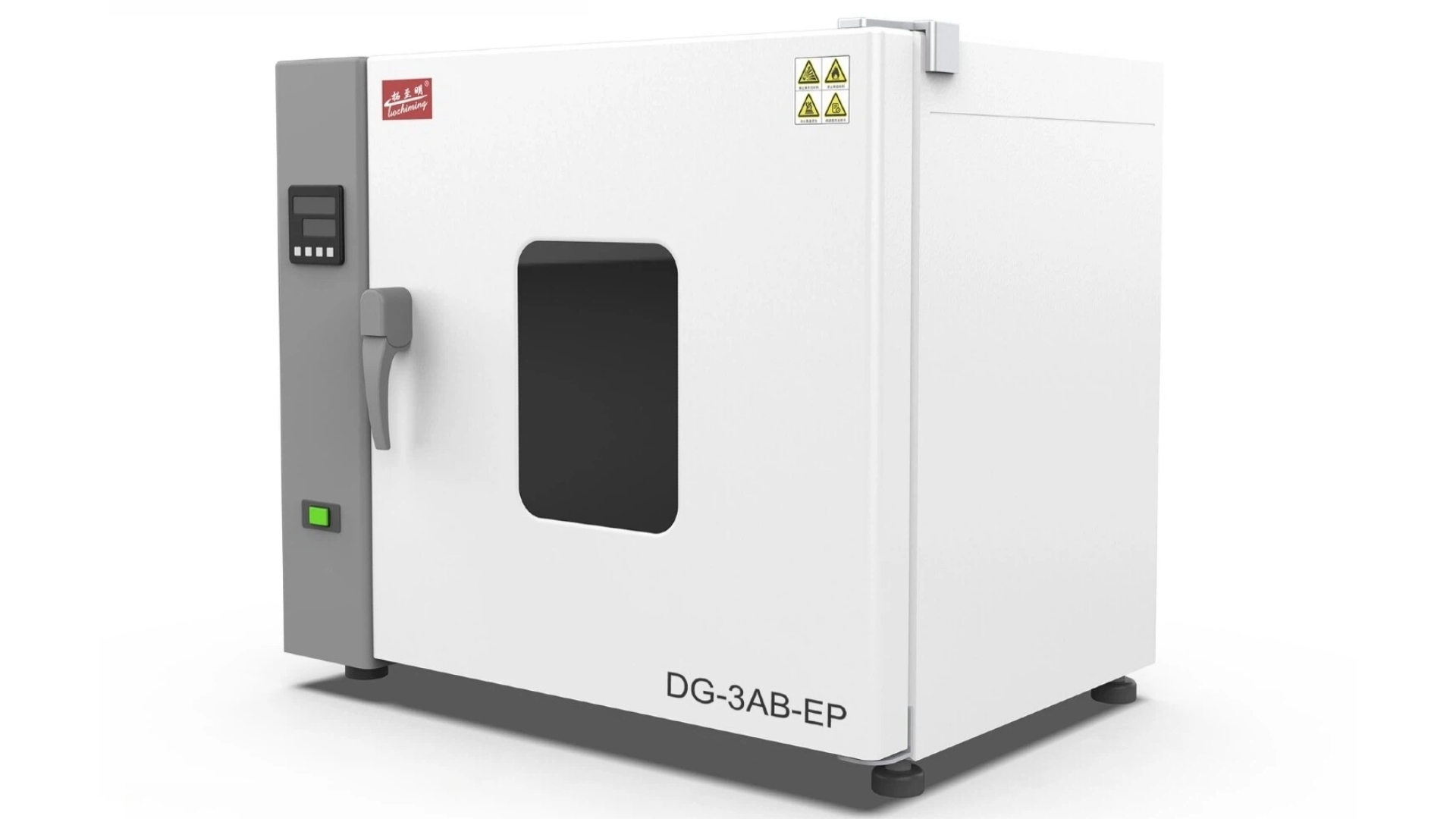
Tuozhiming's electric lab drying oven range comprises the DG and WG Series forced-air ovens. The published description highlights precise temperature control, dual corrosion-resistant material protection, straightforward operation, and safety-related design features for analytical and microbiology laboratories. The product page does not publish numerical temperature ranges, chamber volumes, or temperature-uniformity figures, so those values must be confirmed with the supplier for the exact model under consideration.
When evaluating corrosion-related features, ask which surfaces are protected, what materials are used in the chamber, and what cleaning practices are supported. Also ask what samples or vapors are excluded from normal operation. A conventional drying oven should not be treated as a substitute for a dedicated solvent-handling, vacuum, or other specialized system simply because its exterior is described as corrosion-resistant.
Installation questions deserve equal weight. The laboratory should confirm the required power supply, ventilation and clearance instructions, door access, and safety controls for the quoted unit. These items belong in the purchasing checklist even when the initial need sounds as simple as drying material at a fixed temperature.
Drying Oven vs Muffle Furnace: Where Each Belongs
A drying oven and a muffle furnace serve different stages of laboratory thermal preparation. A drying oven is selected for controlled heating and moisture-removal procedures within its specified operating range. A muffle furnace is the relevant category to investigate when a method calls for high-temperature ashing rather than ordinary drying. A drying oven should not be assumed to provide furnace conditions merely because both devices use heat.
This distinction is particularly important when a laboratory is designing a sequence that includes both drying and ashing. Identify each method's temperature, apparatus, and sample-container requirements separately, then choose equipment for the applicable stage. A dedicated muffle furnace selection guide is the appropriate next topic if ashing, rather than drying, is the main requirement.
FAQ
Is a forced-air oven better than a gravity convection oven?
Forced air generally supports quicker drying and more even temperature distribution. Gravity convection is often better when low turbulence matters, such as with very light or delicate materials. The method and sample determine the preferred option.
What temperature range should a laboratory drying oven have?
Choose a rated range that includes every temperature specified in your procedures, then verify control and uniformity at the actual operating points. Category-level temperature ranges do not substitute for model data.
Can a laboratory drying oven sterilize glassware?
Some hot-air processes are used for sterilization, but an oven must be suitable for the validated exposure and load. A published guide describes at least 160 °C for 45–60 minutes followed by slow cooling; laboratories should follow their governing procedure.
Why does shelving affect temperature performance?
Shelves and loaded containers influence the space available for air circulation. The usable capacity and temperature distribution should be considered together rather than inferred from chamber volume alone.
Are DG and WG Series ovens vacuum ovens?
No. The published range is described as forced-air convection equipment. Vacuum operation and other specialized chamber conditions should not be assumed.
To evaluate a DG or WG Series configuration, send Tuozhiming your required temperatures, sample dimensions, chamber loading, and installation constraints, then request a quote with the model-specific specifications you need confirmed.